Historical Background
THE EARLY DOLLARS OF THE U.S. 1794-1804
by R.W.Julian
Coinage
Background
With the fall of Rome in the fifth century of our era, there
arose in Europe a collection of petty kingdoms. It was not
until the age of Charlemagne (768-814) that the practical
concept of the great nation once more was seen in Europe.
Under this ruler trade was encouraged, and coinage was used
by the common man for the first time in centuries.
Prior to Charlemagne, traders and merchants were more accustomed
to using gold coins, but beginning about A.D. 755 the French
issued small thin silver coins called deniers. A few years
later, King Offa of Mercia (an early English kingdom) struck
high-qual¬ity silver pennies. For centuries the English
were known for issuing the best coinage in Western Europe,
and it was widely imitated in other countries.
As European trade began
to expand there was a need for a larger coin than just the
simple penny or one of the numerous equivalents struck throughout
the continent. In 1202 the city-state of Venice introduced
the grosso. By the end of the century most European nations
had issued similar coins. Beginning in 1280, for example,
King Edward III of England struck the groat, equivalent
to four pennies.
With the introduction of
the grosso and its imitations, trade became less confined.
Payments were made easier for larger amounts. Gold began
to be struck in quantity during the thirteenth century,
although West Europeans had used Byzantine gold for centuries.
However, the power of Constantinople was visibly declining
during this period, and its coinage was increasingly debased.
The First "Silver Dollar"
A combination of small gold coins and larger silver served
Europe reasonably well into the fifteenth century, but the
ever-growing trade within the Continent and abroad mandated
increased supplies of coin. In 1486 Archduke Sigismund of
Tyrol struck the first dollar-sized silver coin. Its formal
name was guldengroschen, but this was soon shortened to
gulden or guldiner. It was meant to be equivalent with the
gulden, one of the important European gold coins.
Sigismund was a pioneer
in the field of large silver coins and proved to be well
ahead of his time. It was not until about 1520 that the
counts of Schlick in Bohemia (later part of Czechoslovakia)
took the guldiner concept to its logical conclusion and
began the striking of large silver coins on a regular basis.
Most of the silver for the
Schlick coinage came from rich mines in the valley of St.
Joachim (Joachimsthal). These coins became known as Joachimsthalers,
which was soon shortened to thalers (or talers). By the
middle of the sixteenth century large silver coins, based
on the thaler, were being struck all over the continent.
Many of the countries simply used a derivative name to show
the value of their coinage. Sweden, for example, struck
dalers while Dutch provinces coined Leeuwendaalders (lion
dollars) from 1575 to about 1713. Petty German states in
particular coined thalers, and even multiple thalers became
almost common. These coins were frequently used as commemoratives
and royal propaganda for the ruling house.
Spanish-American Silver Coins
In Spain, where vast wealth from the New World was pouring
into her coffers, the government chose to coin pieces of
eight reales, roughly equivalent to the thaler. Mints were
established in the Americas to coin silver, and it was not
long before the eight reales denomination was struck there
also. However, most of the silver struck until the middle
of the eighteenth century at Spanish-American mints was
in the form of the extremely crude "cob" coins,
well known to collectors. Such silver pieces were made by
slicing planchets off the end of long silver bars, or "cobs."
Mexico City was the first (in 1732) of these mints to abandon
the old hammered coinage in favor of the screw press.
Coins of the American Colonists
In what is now the United States permanent settlements from
England were established as early as 1607 at Jamestown,
but it was decades before the colonists had much in the
way of coined gold or silver. Prior to 1650 most trade in
this country was on the barter system, and coins were as
rare as the proverbial hen's teeth.
In 1652, in an effort to
bring stability to the marketplace and also provide a circulating
medium to the hard-pressed colonists, the Massachusetts
General Court authorized the famous "NE" silver
coinage. These first crude coins, which were struck for
only a short time, used Spanish eight reales as well as
Dutch daalders for their raw material. The Massachusetts
coins were lighter than their British counterparts to keep
them from circulating outside Massachusetts Bay. Later issues
of Massachusetts silver had a tree on the obverse ("pine
tree shillings," etc.). The coinage ended about 1682.
This first coinage by the
English colonies in America was due to the interregnum in
England. King Charles I had been beheaded in 1649 and the
government was effectively controlled by Oliver Cromwell,
soon to become the Lord Protector. Cromwell did not especially
concern himself with colonial affairs, unlike the royal
government, and many of the colonies were virtually independent
until Charles II recovered the throne in 1660.
Most of the Spanish and
Dutch silver coin that was brought to the colonies came
from the well known—and illegal—commerce with
the West Indies and Africa, the so-called triangular trade.
Slaves and rum were key ingredients, and profits were taken
in silver and, to a lesser extent, gold. The English government
had enacted strict mercantile laws to keep the colonists
from trading with areas reserved for English merchants,
while Spain forbade all English men to trade with their
colonies. Neither prohibition was very effective against
the Yankee ship captains, however.
By the 1690s at the latest, the term "dollar"
was in widespread use throughout the English colonies in
America to describe the Spanish eight reales and the Dutch
daalder. The latter was usually called a Lion Dollar to
distinguish it from the Spanish dollar of eight reales.
Contracts requiring monetary payment in silver coin almost
always stipulated the Spanish or Lion dollar by name because
of their reputation for quality.
The Dutch, for internal
political reasons, began to strike fewer Lion dollars toward
the end of the seventeenth century, and by 1700 they were
virtually a thing of the past. In America the Spanish dollar
gradually became the single accepted standard of value and
the yardstick by which all other monies were judged. Colonies
had begun to issue paper currency in the 1690s, and its
circulating value depended upon the rate of conversion into
Spanish silver coin.
It should be noted that the Spanish dollar was not the only
silver coinage to be used in the colonies. The Mexico City
Mint as well as several others-struck a considerable number
of fractional pieces, such as half real, real, and two reales
coins.2 Other denominations were made but never achieved
widespread use.
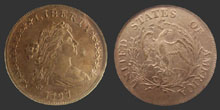 |
| 1797
S$1 BB-71, B-3 |
| NGC
AU55 10x6 Large Letters |
| Inquire |
SOLD |
Beautiful
Early Silver Dollar, BB71, R-2 and a solid date
for Red Book variety collectors. Wonderfully
original + choice.
|
|
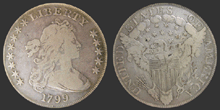 |
| 1799
S$1 B-23 |
| ANACS
F12 , CLEANED |
| Inquire |
SOLD |
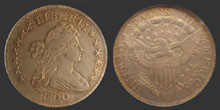
1799
B.23. 8X5 Stars. Fine. A light patina over surfaces
that have seen a light cleaning.
|
|
 |
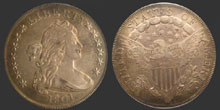
| 1800
S$1 |
| NGC
AU58 BB-187 |
| Inquire |
SOLD |
Wholesome
and wonderfully original early silver dollar.
BB-187, R-2 with an incredible strike, so nice
that one can count the hairlines over Miss Liberty's |
|
 |
| 1801
S$1 |
| PCGS
AU50 |
| Inquire |
SOLD |
R-3.
Long recognized as a date that just doesn't
present itself well. This 1801 specimen is well
struck and solid for the grade. |
|
|